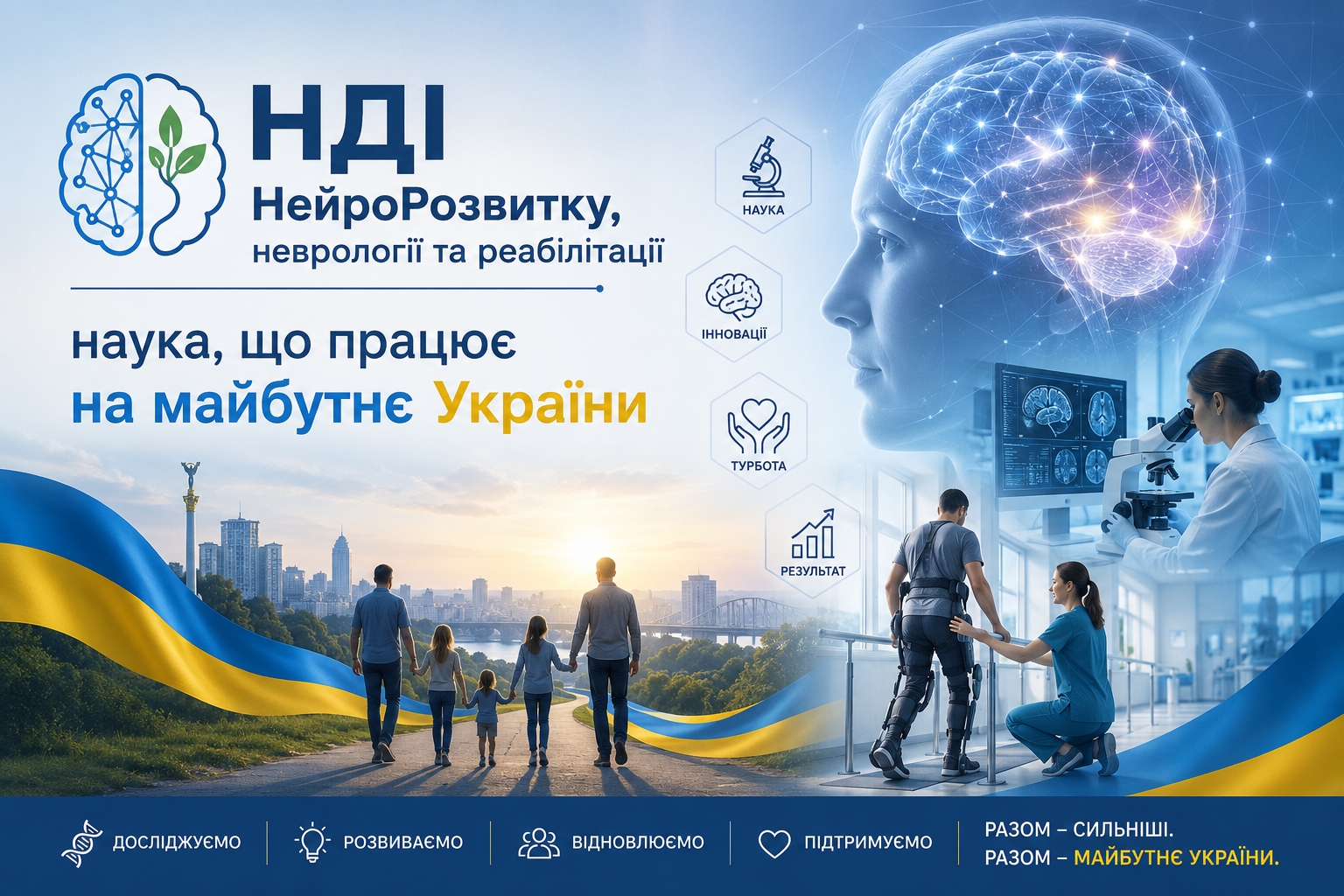
Research Institute of Neurodevelopment, Neurology and Rehabilitation: science working for Ukraine's future
The war is costing Ukrainians their health. According to World Health Organization research, two out of three people report that their health has worsened compared with the pre-war period. The most common problems include disturbances…
The war is costing Ukrainians their health. According to World Health Organization research, two out of three people report that their health has worsened compared with the pre-war period. The most common problems are:
- sleep disturbances (72%),
- headaches and migraine (59%),
- symptoms of anxiety, depression and post-traumatic stress disorder (54%).
In neurology, the number of diagnoses made has more than tripled compared with 2022.
What happens to the brain today determines what our tomorrow will look like: it concerns learning, the ability to work and relationships within the family. In wartime, when the load on the nervous system sometimes seems unbearable, research into neurodevelopment, neurology and rehabilitation ceases to be a purely academic matter and becomes a question of national resilience.
It is precisely at this intersection — of science, clinical practice and the real needs of the population — that the Research Institute of Neurodevelopment, Neurology and Rehabilitation works.
Child and adult neurology
Neurological disorders are among the leading causes of reduced quality of life, disability and loss of the ability to work, in children as well as in adults. The Institute treats neurology as a continuous process — from early childhood into adulthood — with particular attention to transitional periods.
Data are studied and systematised in the following areas:
Epilepsy and disorders of brain activity — various forms of epilepsy in children and adults, drug-resistant cases, cognitive and behavioural seizures, the impact on a child's development and on the family's quality of life.
Headache and pain syndromes — migraine and its neurobiological mechanisms, tension headache, chronic pain syndromes, and the effect of stress and war on the frequency and severity of pain.
Movement disorders — cerebral palsy, dystonias, tremor, tic disorders, impaired coordination and balance.
Neuromuscular diseases — muscular dystrophies, hereditary and acquired myopathies, neuropathies, and needs for rehabilitation and support.
Genetic neurological conditions — hereditary syndromes, genetic causes of epilepsy and neurodevelopmental disorders, the role of genetic testing in clinical practice.
Neurodegenerative diseases — Parkinson's disease, dementias of various types, early signs of cognitive decline.
The impact of war on neurological health — a separate and increasingly relevant area: the frequency of neurological symptoms among civilians, the effect of chronic stress on the nervous system, the overlap of neurological and mental disorders, the neurological consequences of injuries and wounds, and access to care.
The Institute views neurological conditions not only as medical diagnoses but as factors that shape a person's life as a whole — cognitive functions, emotional state, behaviour, social adaptation and the family's role in supporting the patient.
Data and education — the infrastructure for change
A separate strand of the Research Institute's work is analytics: its specialists study the epidemiology of neurological conditions in Ukraine, how the war is changing the pattern of illness, how effective clinical interventions and rehabilitation are; they forecast rehabilitation needs and use the collected data to shape treatment policy.
An equally important strand is education and knowledge sharing — the bridge between science and practice. The Institute's task is to find out what hinders the adoption of current clinical guidelines and why, and to assess how effective different formats of training and professional preparation are – (online, in person, simulations); to upgrade the skills of doctors and medical staff and to run pre-hospital first aid courses open to anyone.
The Institute is currently focused on two interconnected strands: providing information services and researching the war's impact on public health. One of the tools that helps with this is – NeuroCare Tracker Bot. It is already running and is useful to patients, clinicians and researchers at once. It is a Telegram application for keeping a structured medical diary.
What the bot can do:
🔹 recording epileptic seizures and other clinically significant events; 🔹 keeping a headache diary with detailed symptoms; 🔹 tracking medication intake with reminders;
🔹 storing important information about the course of the illness;
🔹 building a history of observations for the doctor.
Practical benefits for the doctor:
✔ more reliable data during the consultation;
✔ objective measurement of seizure frequency and symptoms;
✔ assessment of responsiveness to treatment;
✔ monitoring the effectiveness of therapy over time;
✔ easier clinical decisions based on real data;
✔ less reliance on the patient's memory when taking the history
NeuroCare Tracker Bot is especially useful for patients with epilepsy, migraine, functional neurological disorders, chronic conditions requiring regular medication, and conditions where long-term symptom monitoring matters.
The tool's purpose is simple: to help patients keep better track of their own health and to give doctors better information for clinical decisions.
The Research Institute also pays attention to disaster medicine: like first aid, this knowledge and these skills may be needed in real life, and in wartime they are especially relevant.
The Institute's specialists work with neurodivergent children — they carry out assessments and give practical advice on how the child and the family can live with this;
An EEG examination is available. Priority goes to – veterans, service members and neurodivergent children, but the service is open to other patients as well.
Priority: the consequences of war
The Institute's priority remains research into the war's impact on public health: neurotrauma among service members, restoring function and the ability to work, the family's role in rehabilitation, and child development under chronic stress.
The Institute does not reduce its work to diagnoses. Its focus is development as a process, the child as a person, the family as a system and the environment as a factor. The approach is multidisciplinary, evidence-based, individualised and oriented towards long-term results.
How the health system responds to the neurological consequences of the war determines how fully veterans and civilians will be able to return to active life.
By investing in neurological health, the Institute invests in the country's future — for the recovery of everyone the war has harmed.
https://bot.nnrri.eu/